

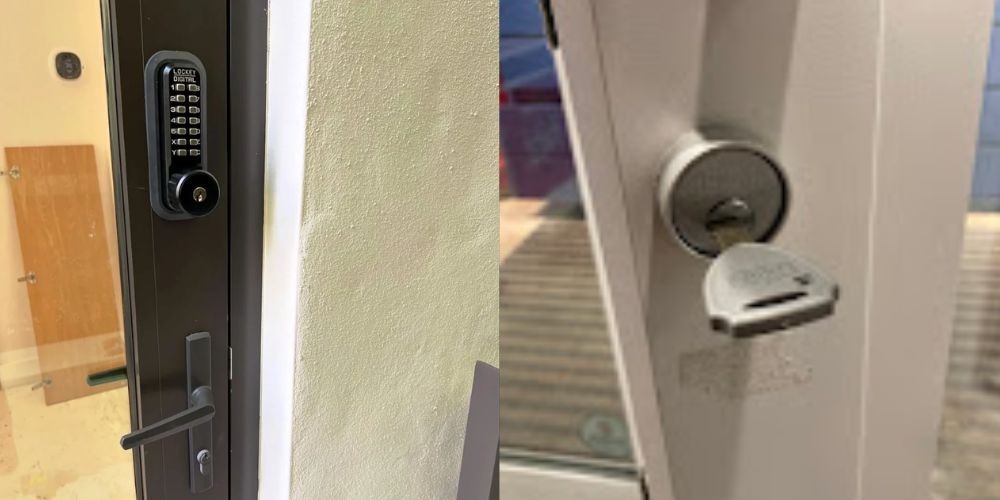
Smart locks have become common in Miami Beach homes and condos. A lot of owners now wonder if they should replace a working deadbolt with one. There is no single answer, since the right choice changes from one door to the next.
What matters is your door and how you use it. Smart locks in Miami Beach have to deal with salt, heat and storms, and key locks come with lost keys and copies floating around. This post puts both side by side, no sales talk, just what we see on actual doors.
What’s on your door right now?
Go look before you shop. A thumb turn on the inside means single cylinder. A keyhole on both sides means double, and that one needs extra thought with smart locks.
Smart Lock Basics
It’s a regular lock with a motor and a keypad or app stuck on. You can open it with a code, a phone, a fingerprint or a fob, instead of just a key. Some keep a log of who came in. Some hook up to Wi-Fi, some don’t, and honestly most people are fine without it.
A traditional lock is the metal key kind. There are a few common door lock types, like deadbolts, knobs and lever handles, all of that. No batteries, nothing to update. Most smart locks still have a key slot for backup but a few don’t, so read the box before you buy one.
What Miami Beach Does to a Lock
Locks don’t have an easy life here. Between the ocean air and the sun, one that would last years inland can look beat up pretty fast.
- Salt air: Rust. It starts at the screws and the keyhole, then cheap finishes pit and stick.
- Humidity: Wet air creeps into keyholes and keypads. Stuff swells, stuff corrodes.
- Sun and heat: A door facing the sun gets baked. Batteries and plastic don’t love that.
- Wind and spray: Out on Key Biscayne the doors get salt spray most days, so Key Biscayne door locks have to be built tougher.
- Storms: The door has to shut and latch fully or the seal’s off. A worn lock or latch can be the reason it doesn’t.
Smart Lock Types You'll See in Stores
Keyless entry door locks come in a few flavors and they don’t all act the same. Here’s a quick rundown before you buy. Easy to mix them up.
- Keypad locks: You type a code, that’s it. Most people get the hang of them quick. Good for families and guests.
- Bluetooth smart locks: They open with your phone when you’re close by. Easier on the battery but the range is short, like really short.
- Wi-Fi smart locks: You can lock and unlock from anywhere. Handy, sure, but they eat batteries faster and need a steady connection.
- Fingerprint door locks: No code to remember: They struggle with wet or sandy fingers though, which happens a lot near the beach.
- Smart deadbolts you add to your old lock: These go over the deadbolt you already have, so you keep the same key. Decent if you rent.
Smart Locks vs. Traditional Locks at a Glance
Rough guide only. Brands and models change a lot of the details.
| Feature | Traditional Lock | Smart Lock |
|---|---|---|
| How you open it | Metal key | Code, phone, fingerprint, fob, or key |
| Power needed | None | Batteries |
| Sharing access | Copy keys | Send or delete codes |
| Lost key | Rekey or replace | Delete the code |
| Entry history | None | Often available |
| Up-front cost | Lower | Higher |
| Power outage | Works fine | Usually works, key or new batteries help |
| Salt air | Depends on the finish | Depends on finish and electronics |
| Needs Wi-Fi | No | Some models |
Where Smart Locks Win
If you’re looking at smart lock installation in Surfside or nearby, these are the real upsides.
- Easy sharing: Send a code to a guest. Delete it when they leave.
- Lost keys: You remove a code, you don’t change a lock.
- Rentals: Timed codes save a lot of key swapping.
- No hiding spots: No more spare key under the plant pot.
Where Smart Locks Let You Down
They’re not perfect. People don’t say that enough, so we will.
- Dead batteries: Most locks beep a warning first, but people ignore it.
- Cheap models: Humidity kills a lot of the low-priced ones.
- Tech glitches: Apps update, Wi-Fi drops, keypads get stubborn.
- Bad doors: A smart lock can’t fix a loose frame or a weak strike plate.
Are Smart Locks Secure?
This is the one people ask about most, and fair enough. Smart locks can be attacked, sure, same as any lock can be picked or forced. But most break-ins aren’t about hacking. They go after a weak door, short screws in the strike plate, or a code somebody guessed. A smart lock with a strong bolt is usually harder to beat than a cheap key lock, honestly.
A few things help a lot. Check the lock’s grade first. The ANSI/BHMA ratings go from Grade 1, the strongest, down to Grade 3. Skip birthdays and 1234 for your code, and don’t use the same one everywhere. Update the app if your lock has one. Oh, and the door matters too. A loose frame is still a loose frame, no matter how smart the lock is.
Why Plain Key Locks Still Make Sense
Key locks are boring, yeah, and that’s kind of the point. Nothing to charge, nothing to update. A good deadbolt with a rust-resistant finish can go for years and costs less too. For a bedroom or a closet or a side door a regular lock is plenty.
The weak spot is the key. Keys get lost, copied, handed out to people you forgot about. When that happens the usual fix is rekeying, where the lock stays but the old keys stop working. It’s quick and it costs less than a whole new lock.
Condos: Check the Rules First
Condos have extra layers houses don’t. A lot of unit doors are fire rated, so drilling or swapping parts the wrong way can cause problems. Some associations pick the hardware for every door, and staff or emergency crews may need a way in too. Read your rules or ask the manager before ordering anything.
This comes up a lot with South Beach condo locks, since so many units get rented out and owners want codes. A smart lock can work well there if the building allows it. If a building wants shared entry doors for everybody, that’s a different job, usually done with an access control system like fobs or cards at the entry doors.
Can You Use Both?
Lots of people do. A regular deadbolt on the front, a smart lock on the back or garage door. Or one smart lock that also takes a key, so a dead battery doesn’t shut you out.
Keypads fail sometimes, that’s just how electronics are. A Sunny Isles Beach locksmith can get you in when one does, but a backup key saves the wait. Getting shut out is a different problem. A house lockout is normally handled with special tools, so the door and lock don’t get damaged.
How to Pick for Your Own Door
Think about who uses it and how often.
- Lots of people come and go: A smart lock makes sharing easier.
- You rent out your place: Get one with timed codes.
- You live near the water: Look for a coastal finish, whichever type you pick.
- Your door is old or crooked: Fix the door first.
- Just one or two people use it: A solid key deadbolt is fine.
Costs depend on the lock and the door. Most of the difference comes from the lock itself and how much door work it needs, and flat pricing makes that easier to plan for.
Choosing the Right Lock for Your Home
We work out of our shop on Harding Ave, so we see and work with these types of door locks every day. If a neighbor asked us which option to choose, we’d explain that there is no single solution that works for everyone. A smart lock can be a convenient choice for homes where multiple people need access, while a traditional deadbolt is a dependable option for those who prefer simple, straightforward security. The right choice ultimately depends on your home’s needs, access requirements, and personal preferences.
Any decent locksmith in Miami Beach will tell you the install matters more than the brand. A cheap smart lock on a loose door is worse than an old deadbolt on a solid one. Fit is the first thing a residential locksmith checks, like door thickness, bolt hole size and the strike plate. Using both types is fine too, plenty of people do.
Want a Second Opinion on Your Door?
Call Best Locksmith at (305) 770-6863 or stop by 7109 Harding Ave in Miami Beach. We’ll check your door, talk through smart and key options, and give you a price before we start any work. Ask us about installing a smart lock at your home or condo.


